
This post may contain affiliate links. As an Amazon Associate I earn from qualifying purchases. If you choose to make a purchase, I may earn a small commission at no extra cost to you.
Choosing the best tires for Porsche Taycan starts with more than matching a familiar size. The car puts substantial weight on its tires, and instant electric torque can wear tread quickly. A tire that suits a lighter car may not carry the right load or preserve the quiet, steady ride you expect from this electric sedan.
Check the tire size, load index, and speed rating on your door-jamb label or owner’s manual, then match your usual weather and driving. The options below cover daily comfort, warm-weather grip, occasional snow, and track use, so you can choose around the way you drive in 2026. A careful match can also help preserve range and keep handling predictable.
Our Top Tires for Porsche Taycan Picks


More Details on Our Top Picks
Pros
- Compound warms up quickly
- Strong wet-weather focus for a summer tire
- Steel belts support steering response
- Select versions offer noise control or puncture sealing
Cons
- Summer compound does not suit winter conditions
- Features vary by version
The Pirelli P Zero PZ4 brings a quick, planted feel that fits the Taycan’s performance character. Pirelli tunes its summer compound to warm up quickly and keep grip in wet conditions, so the tire responds without needing a long run to reach its working feel.
Reinforced steel belts give the tire a firm base under steering inputs. Its ribbed tread layout adds cornering stability, giving you a direct, composed response when you change direction.
Pirelli also shapes the tread to reduce rolling resistance and road noise. That quiet, efficient approach suits an electric sedan, where tire hum can stand out and rolling drag affects energy use.
Some versions add Pirelli Noise Cancelling System, which uses foam inside the tire to cut cabin noise. Others offer SealInside sealant for certain tread punctures or run-flat construction, and the Pirelli P Zero PZ4 combines those options with a responsive warm-weather design.
Bottom line: Choose the Pirelli P Zero PZ4 if you want a performance summer tire with a quiet, refined edge for spirited Taycan driving.
Pros
- Separate tread compounds target dry and wet grip
- Aramid and nylon belt supports steering precision
- Strong wet braking
- Racing-derived design
Cons
- Not intended for snow or freezing conditions
- Summer compound limits cold-weather use
Michelin’s Bi-Compound tread gives the Michelin Pilot Sport 4S its distinctive mix of dry grip and wet control. Michelin uses one rubber blend along the outer shoulder for dry cornering and another across the inner tread for wet-road traction.
Lessons from endurance racing shape this tire’s high-speed road manners. Its Dynamic Response Technology uses a belt made with aramid and nylon to keep the tread stable under load, which helps the steering feel precise as you push through a fast bend.
That control makes the Pilot Sport 4S a natural candidate for a Taycan-focused performance lineup. You get strong dry grip and confident wet braking, two traits that matter in a powerful car that can build speed quickly.
The model has earned attention from Porsche, Ferrari and Mercedes-AMG, reflecting its place in the high-performance summer tire market. The Michelin Pilot Sport 4S keeps that sporting focus without losing its composed road feel, though its warm-weather design calls for a seasonal set-up.
Bottom line: The Michelin Pilot Sport 4S suits Taycan drivers who put warm-weather grip and sharp steering ahead of year-round use.
Pros
- Flexible compound maintains wet-road contact
- Asymmetric tread responds quickly in turns
- Tread design targets low road noise
- Lightweight construction
Cons
- Summer performance limits use in cold weather
- No all-season snow capability
A flexible tread compound gives the Goodyear Eagle F1 Asymmetric 6 a useful edge when rain covers the road. It flexes against wet surfaces to maintain traction, while its asymmetric layout delivers quick response through turns.
That mix of wet grip and precise handling earns it a place in a Taycan-focused tire roundup. Goodyear also designs the tread to keep road noise low, a welcome trait in an electric car, where cabin quiet can make tire sounds more noticeable.
On dry pavement, the tire’s contact with the road supports stable, responsive driving. Its lightweight construction also keeps the design focused on agility rather than adding bulk to the wheel assembly.
The Eagle F1 Asymmetric 6 brings a sporty character without leaning on track-only traits. Its quiet tread design and wet-road focus round out the Goodyear Eagle F1 Asymmetric 6, making it useful for drivers who want performance manners during regular road trips as well as spirited drives.
Bottom line: The Goodyear Eagle F1 Asymmetric 6 fits Taycan drivers who want agile handling with extra attention to wet grip and road noise.
Pros
- Racing-focused summer design
- Broad tread contact areas
- Firm shoulder support for cornering
- Built for warm-weather track use
Cons
- Less suited to standing water
- Track focus limits everyday versatility
Track-focused grip defines the Pirelli P Zero Trofeo RS. Pirelli builds this summer tire for racing applications, with a competition-oriented tread and compound aimed at high grip in warm conditions.
That focus gives the tire a place in a Taycan performance roundup for drivers who take their car to track events. Its broad tread contact areas and firm shoulder support give you the response needed to hold a line through hard corners.
On a circuit, precise steering and grip under load matter more than the easygoing feel of a touring tire. The Trofeo RS puts those priorities first, giving a powerful car a tire built for fast laps and demanding cornering.
The Pirelli P Zero Trofeo RS has a specialized role, and its performance depends on warm conditions and a dry track surface. Its limited tread grooves leave less room to clear standing water, so heavy rain can cut into its grip.
Bottom line: Choose the Pirelli P Zero Trofeo RS for track days where dry grip and precise response matter more than all-weather flexibility.
Pros
- All-season traction for wet and dry roads
- Original-equipment tuning
- ContiSilent foam on select versions
- ContiSeal puncture protection on select versions
- Limited tread life coverage up to 65,000 miles
Cons
- Steering feel favors touring over track use
- Noise and sealant features vary by version
The Continental ProContact RX brings an all-season approach to performance driving, with wet and dry traction plus responsive handling. Continental tunes the model for original-equipment use, giving it a road-focused balance that fits a Taycan shortlist for drivers who want one tire for changing conditions.
Continental offers ContiSilent on some versions. A layer of polyurethane foam inside the tire absorbs noise, which can make a noticeable difference in the quiet cabin of an electric sedan.
Some versions also use ContiSeal, a sealant on the inner liner that can close certain tread punctures from sharp objects. These features vary across the line, but the Continental ProContact RX has a clear comfort and convenience focus.
Continental backs the model with limited tread life coverage of up to 65,000 miles. That adds a long-term ownership benefit to its balanced road handling, while the tire keeps a more touring-oriented feel than a track-focused summer model.
Bottom line: The Continental ProContact RX suits Taycan drivers who value all-season road manners, cabin comfort and longer tread life.
Pros
- All-season tread offers light-snow traction
- Wet braking focus
- Durable compound
- Built-in tread wear indicators
- Limited tread life warranty up to 45,000 miles
Cons
- Light-snow grip cannot replace a winter tire
- Less suited to severe winter conditions
Light-snow grip sets the Goodyear Eagle F1 All Season apart from a summer-only performance tire. Its sporty tread pattern gives you year-round traction, while strong wet braking helps keep the car composed through heavy rain.
That flexibility earns the Goodyear Eagle F1 All Season a place in a Taycan tire roundup for drivers who face changing weather. It carries a more performance-minded feel than a basic commuter tire, yet it still addresses rain and light snow.
Goodyear uses a durable compound to maintain all-season performance over time. Built-in wear indicators show how the tread wears, and the model includes a limited tread life warranty of up to 45,000 miles.
For daily driving, the tire balances wet control with the added reach of an all-season design. The Goodyear Eagle F1 All Season keeps that sporty emphasis, but its snow performance suits light conditions rather than severe winter weather.
Bottom line: The Goodyear Eagle F1 All Season works for Taycan drivers who need sporty road manners through rain and occasional light snow.
Pros
- Solid center rib sharpens steering response
- Silica compound targets wet and dry grip
- Contoured profile supports high-speed stability
- Silent Sipe Technology cuts tread noise
- 30-day satisfaction trial through Yokohama’s Promise
Cons
- Summer tread does not suit winter driving
- Less versatile in cold weather
A solid center rib gives the Yokohama Advan Sport V107 crisp steering response on dry pavement. Yokohama pairs that layout with a rayon matrix body ply and an asymmetrical tread to support cornering control.
The ultra-micro silica compound targets grip in both wet and dry conditions, making the V107 a fitting summer option for a performance-focused Taycan lineup. Its contoured profile also promotes stability at high speed, where a steady contact patch can help the car feel composed.
Yokohama adds Silent Sipe Technology to reduce tread-pattern noise. That detail suits an electric sedan, where tire noise can become a bigger part of the drive than engine sound.
The Yokohama Advan Sport V107 combines quick response with a more settled ride feel than its sharp steering might suggest. Yokohama’s Promise program includes a 30-day satisfaction trial, adding a short evaluation period to this high-performance tire’s appeal.
Bottom line: The Yokohama Advan Sport V107 fits Taycan drivers who want direct steering, high-speed stability and a quieter ride in warm weather.
Pros
- SportPlus Technology targets grip and responsive handling
- Strong wet and dry braking
- Snow and ice capability
- DWS indicators track tread performance
- Limited tread life coverage up to 50,000 miles
Cons
- Severe winter conditions call for a dedicated winter tire
- Snow grip depends on remaining tread
The Continental ExtremeContact DWS06 Plus gives you all-season grip with a clear focus on wet and dry braking. Continental uses SportPlus Technology to bring responsive handling and grip together with long tread life.
Its snow and ice performance makes it a useful year-round option in a Taycan tire roundup, especially if your driving includes occasional winter weather. The DWS tread indicators show whether the tire still has its intended dry, wet and snow performance as the tread wears.
Continental designs the tread to deliver short braking distances on both wet and dry roads. That response gives the tire a strong road-going character, while its all-season design adds more cold-weather range than a summer performance tire.
The DWS06 Plus includes limited tread life coverage of up to 50,000 miles. Its Continental ExtremeContact DWS06 Plus tread design also balances grip with a sporty look, though dedicated winter tires remain better suited to severe snow and ice.
Bottom line: The Continental ExtremeContact DWS06 Plus suits Taycan drivers who want sporty handling and useful snow capability in one all-season tire.
Factors to Consider When Choosing Tires for Porsche Taycan
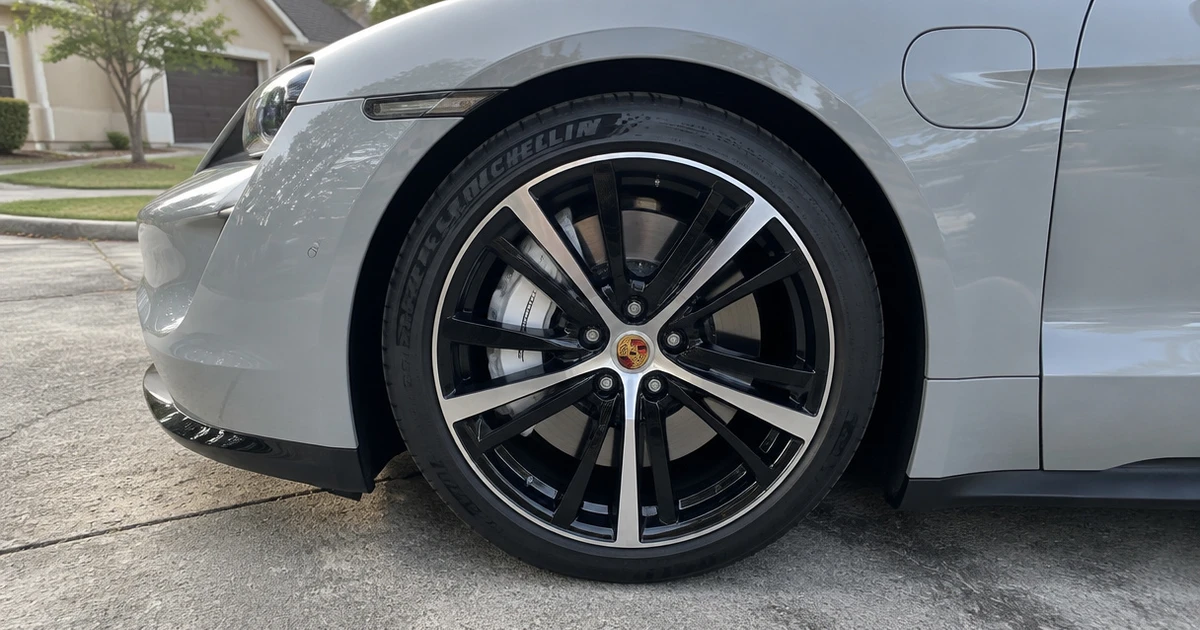
A Taycan needs tires that match its factory fit, not simply a familiar size that fits the wheel. Start with the car’s placard and manual, then weigh climate, road surface, and driving style. The right choice balances load capacity and handling with comfort, noise, and tread life; one tire cannot excel in every setting.
Factory Fit and Load Capacity
Read the tire size, load index, and speed rating on the driver-door label or in the owner’s manual. Match all three, along with the recommended wheel position, because some Taycan setups use different sizes front and rear. A tire with the right diameter but too little load capacity is still the wrong fit.
The load index matters because the battery adds substantial mass and the car can accelerate hard. Do not choose a lower index to soften the ride. Check whether Porsche specifies an approved tire marking for your exact trim, and follow that guidance if you want to keep the car close to its original response.
Before you buy, confirm:
- The full tire size for each axle
- The required load index and speed rating
- Any approved tire marking in the manual
EV Torque and Range
Electric torque arrives quickly, and the Taycan’s weight can put more stress on tread during hard starts and cornering. Look for a tire whose construction and load rating suit a powerful EV, but do not assume an EV label alone guarantees better range or longer life. Rolling resistance, tread compound, alignment, and your driving style all affect energy use.
Lower rolling resistance can help the car travel farther on a charge, but a low-resistance design may feel less eager at the limit than a tire built for sharp grip. Decide what matters on your routes. If you commute mostly on smooth roads, prioritize efficiency and even wear; if you drive hard, favor stable grip and accept that tread may wear sooner.
Climate and Seasonal Grip
Choose tires for the coldest conditions you regularly face, not just the weather on purchase day. Summer compounds deliver strong grip in warm conditions but lose flexibility as temperatures drop. All-season tires suit mild climates and changing seasons, while dedicated winter tires offer better traction on snow and ice.
If you encounter frequent snow or sustained freezing temperatures, choose a tire marked for severe snow service and use it as a matched set. In a warm region with occasional flurries, an all-season option may work better. Check local rules for winter equipment, and plan seasonal changes before temperatures regularly fall.
| Type | Best suited to | Trade-off |
|---|---|---|
| Summer | Warm roads and responsive handling | Less grip in cold weather |
| All-season | Mixed, mild weather | Less snow grip than winter tires |
| Winter | Frequent cold, snow, and ice | Faster wear in warm weather |
Ride Noise and Comfort
Road noise stands out in an electric car because engine sound does not mask it. If you drive on rough pavement or take long highway trips, look for a touring-focused tread pattern and a design that limits road noise. A softer sidewall can smooth impacts, though it may reduce the crisp feel you want in quick turns.
Read the tire maker’s stated purpose and check how the tread pattern moves water, since a quiet tire still needs strong wet grip. Wheel size and sidewall height also shape comfort, so keep the approved fitment rather than changing diameter for appearance. Set pressure to the car maker’s cold recommendation; too much pressure can make impacts harsher.
Tread Life, Rotation, and Maintenance
High torque and heavy mass can shorten tire life, especially with repeated hard acceleration, aggressive cornering, or poor alignment. Check tread depth often and inspect inner shoulders, where wear can hide from a casual glance. Uneven wear can point to alignment or pressure problems, so correct the cause before fitting a new set.
Follow the manual for rotation intervals and patterns; staggered front and rear sizes can limit rotation options. Keep cold pressures at the placard values and check them monthly, since pressure changes with temperature. If wear forces you to replace fewer than four tires, ask a qualified shop to confirm that tread depth and tire type remain compatible across the axles.
Frequently Asked Questions
Do Porsche Taycan tires need an EV-specific design?
They do not have to carry an EV label, but they must meet the car’s required size, load index, and speed rating. EV-focused designs may reduce rolling resistance or road noise, yet those features vary. Match the tire to your driving needs and the specifications listed for your exact Taycan.
Can I use all-season tires on a Taycan year-round?
Yes, if your climate stays moderate and you do not regularly drive on packed snow or ice. All-season tires trade some warm-weather precision and winter traction for broader use through the year. If your area has long, cold winters, dedicated winter tires provide more dependable grip in low temperatures.
What tire pressure should I use?
Use the cold tire pressure that the driver-door placard or owner’s manual gives, not the maximum pressure molded into the sidewall. Check all four tires when they are cold, at least monthly and before a long trip. Correct pressure supports handling, tire wear, and driving range.
How often should I rotate Taycan tires?
Follow the interval and rotation pattern in your owner’s manual. Some Taycan fitments use different tire sizes front and rear, which can rule out a standard front-to-rear swap. Regularly inspect tread across each tire, and ask a tire professional to check alignment if one shoulder wears faster than the other.
Should I replace all four tires at once?
Replacing all four keeps grip and handling more even, especially on an all-wheel-drive car. If damage or wear forces you to replace only one or two tires, match the tire type and keep tread depth close across each axle. Have a qualified shop check the remaining tires and the vehicle maker’s guidance before fitting a partial set.