
This post may contain affiliate links. As an Amazon Associate I earn from qualifying purchases. If you choose to make a purchase, I may earn a small commission at no extra cost to you.
Choosing tires for a Solterra takes more than matching the wheel size. Its electric powertrain delivers quick torque, while the battery adds weight, so fit, load capacity, road noise, and rolling resistance can affect how the vehicle feels and how far it travels between charges on familiar routes.
The best tires for Subaru Solterra should suit your climate and routes without sacrificing the handling or comfort you expect from a compact electric SUV. This guide explains the checks that matter before you buy, from sidewall markings to winter traction, so you can compare options for your daily driving habits in 2026.
Our Top Subaru Solterra Tires Picks


More Details on Our Top Picks
Pros
- Three-Peak Mountain Snowflake certified for severe-snow conditions
- Strong wet and dry braking focus
- Tread design handles changing seasonal conditions
- Long-wearing all-season construction
Cons
- Winter-ready tread may reduce range versus efficiency-focused tires
The sweeping V-shaped tread gives the Michelin CrossClimate2 a clear purpose: keep its grip across changing weather. Its Three-Peak Mountain Snowflake certification marks it for severe-snow service, a useful feature when your Solterra faces winter roads.
Michelin pairs that tread with an all-season compound and a design built for wet and dry braking. The broad grooves move water away from the contact patch, while the angled tread blocks provide grip on snow-covered pavement.
In everyday driving, that mix gives you a tire suited to rain, dry highways, and occasional snow without a seasonal swap. The CrossClimate2 also has a reputation for long tread life, so you can get year-round use from its weather-ready design.
For an electric SUV, confident braking and all-weather traction matter as much as a quiet, easy commute. The Michelin CrossClimate2 brings those priorities together, though its winter-focused tread may use more energy than a tire built around low rolling resistance.
Bottom line: Choose this tire if you want one set for varied weather and winter trips. It suits Solterra drivers who value year-round traction over maximum range.
Pros
- Built for electric SUV use
- Focuses on lower road noise
- Tread targets longer service life
- Efficiency-minded design can support driving range
Cons
- All-season tread lacks dedicated winter tire grip in severe snow
Long commutes and quiet cabins suit the Hankook iON evo AS SUV, an all-season tire developed for electric SUVs. Its low-noise design targets the steady road hum that can stand out more in an EV.
Hankook built the iON line around electric vehicle demands, including battery range, high torque, and cabin noise. The iON evo AS SUV pairs a tread compound aimed at longer wear with a structure tuned to reduce road sound.
That balance matters in the Solterra, where tire efficiency can affect how far you travel between charges. You get a tire focused on limiting energy loss while keeping the ride calmer on routine drives, with all-season traction for everyday wet and dry roads.
The Hankook iON evo AS SUV keeps its priorities clear: EV-specific efficiency and a quieter ride. Its longer-wearing tread also suits drivers who put plenty of miles on their Solterra, though its all-season design does not replace a dedicated winter tire in severe snow.
Bottom line: Pick this tire if you want EV-focused efficiency and a quieter cabin. It fits Solterra drivers who spend most of their time on paved roads.
Pros
- 80,000-mile treadwear limited warranty
- Locking 3-D Sipes add wet-road biting edges
- Long-life all-season tread design
- Stable feel for everyday pavement driving
Cons
- Not suited to repeated driving in deep snow
- Less focused on EV range than low-rolling-resistance tires
Michelin’s Defender line is known for long tread life, and the Michelin Defender2 carries that focus into its all-season design. Its Locking 3-D Sipes create extra biting edges that support grip and braking on wet and dry pavement.
The tread blocks lock together as they meet the road, giving the tire a stable feel during everyday driving. Deep grooves move water out from under the tread, while the compound balances traction with wear resistance.
For your Solterra, that long-life approach can mean fewer tire changes over years of commuting and road trips. Michelin backs the Defender2 with an 80,000-mile treadwear limited warranty and a six-year standard limited warranty.
The Michelin Defender2 focuses on steady road manners and durability rather than sporty response. Its all-season tread handles regular rain and dry roads, while the 3-D sipes add useful grip when the pavement turns slick.
Bottom line: Choose the Defender2 if you value long tread life and dependable daily traction. It suits Solterra owners who mostly drive on cleared roads.
Pros
- AquaTred grooves channel water and slush
- Severe-snow designation for winter traction
- Evolving grooves maintain water pathways as tread wears
- Comfort inserts soften road impacts
Cons
- Winter-focused tread may reduce EV range
Rain and slush are the conditions the Goodyear Assurance WeatherReady 2 tackles head-on. Its AquaTred Technology pairs sweeping grooves with a season-ready compound to move water away and maintain traction.
The tire’s Evolving Traction Grooves keep channels working as the tread wears, so water evacuation remains part of its design over time. A severe-snow designation adds confidence for winter roads, while comfort inserts soften bumps and road vibration.
Goodyear also uses a multi-pitch tread pattern, which varies the block sizes to limit the repeating sound tires can make on pavement. In your Solterra, that mix offers a composed ride for wet-weather commutes and longer highway drives.
The Assurance WeatherReady 2 gives you all-season road manners with added winter capability. Its winter-focused tread can trade some efficiency for traction, so drivers who put maximum range first may prefer a tire built specifically around low rolling resistance.
Bottom line: Consider it if rain, slush, and seasonal snow shape your driving year. It suits Solterra owners who want added winter traction without switching tires by season.
Pros
- All-season traction for SUV driving
- Road-focused design for paved routes
- Long treadwear claim
- Performance-oriented handling character
Cons
- Not tailored to maximize EV range or reduce cabin noise
Drivers who spend most of their time on paved roads will find the Bridgestone Alenza Prestige’s SUV-focused design easy to place. Its all-season performance tread targets everyday traction and controlled handling for trucks and SUVs.
Bridgestone gives this tire a road-oriented character, with a design meant for normal dry and wet driving rather than off-road use. The tire’s long treadwear claim gives you a durability angle alongside its pavement-focused performance.
That combination can suit a Solterra used for commuting, errands, and highway trips. You get year-round tread rather than a seasonal setup, with a performance focus that favors predictable response on regular roads.
The Alenza Prestige brings a straightforward SUV touring approach to the Solterra tire list. It does not center its design on electric range or cabin noise, so drivers who prioritize those EV-specific goals may want a tire built around them.
Bottom line: Look at the Alenza Prestige if your Solterra mostly sees pavement and you want an SUV-oriented all-season tire. It suits drivers who value road handling and tread life.
Pros
- Three-Peak Mountain Snowflake certified
- Dense sipes add winter grip
- Low rolling resistance design
- 60,000-mile limited tread life warranty
Cons
- Dedicated winter tires offer more grip on ice
Snow-ready traction is central to the Nokian Remedy WRG5, an all-weather tire with Three-Peak Mountain Snowflake certification. Its asymmetric tread has deep grooves and a dense sipe network that adds grip across winter roads.
Nokian’s all-weather approach gives you one tread for changing conditions instead of a separate winter setup. The grooves clear water, while the small sipes create extra edges that can bite into packed snow and wet pavement.
A low rolling resistance design also suits an electric SUV such as the Solterra, where tire energy use can affect range. Nokian backs the Remedy WRG5 with a 60,000-mile limited tread life warranty, adding a long-use focus to its winter capability.
The Nokian Remedy WRG5 balances snow traction with all-season road use. Its dense winter tread gives you useful grip when temperatures drop, though a dedicated winter tire can offer more bite on ice and in severe snow.
Bottom line: Choose the Remedy WRG5 if your Solterra regularly meets snow and cold weather. It suits you if you want an all-weather tire with a range-conscious design.
Pros
- SoundComfort foam cuts some road noise
- Tread supports wet and dry grip
- Built-in wear gauge tracks tread depth
- Sidewalls absorb road impacts
Cons
- All-season tread gives up deep-snow grip to winter tires
Road noise often becomes more noticeable in an electric car, and the Goodyear ElectricDrive 2 addresses it with SoundComfort Technology. A layer of foam inside the tire absorbs some of the noise that travels into the cabin.
Goodyear pairs that noise control with a tread pattern tuned for wet and dry grip. The tread supports responsive steering, while strong, aerodynamic sidewalls absorb impacts and add stability on ordinary roads.
The ElectricDrive 2 also uses a long-wearing tread design, a practical feature for a Solterra that sees daily commuting. Its built-in wear gauge lets you track tread depth and spot uneven wear that can point to an alignment issue.
On a routine drive, those details focus the tire on cabin comfort and predictable road manners. The Goodyear ElectricDrive 2 gives your Solterra EV-specific noise control, though its all-season tread cannot match a winter tire in deep snow.
Bottom line: Go with the ElectricDrive 2 if a quieter cabin matters on your daily drives. It suits Solterra owners who want EV-focused comfort and all-season road grip.
Pros
- Asymmetric tread supports responsive steering
- Four grooves channel water away
- Micro-silica compound targets wet grip
- Design balances traction and rolling resistance
Cons
- Not intended for severe winter traction
An asymmetric three-rib tread gives the Yokohama Geolandar X-CV a clear emphasis on steering response. The layout supports crisp turn-in and stable cornering, useful traits when your Solterra moves from city streets to highway curves.
Yokohama uses a micro-silica compound with end-locked polymers to balance wet grip and rolling resistance. Four wide circumferential grooves channel water away from the tread, which can reduce the chance of hydroplaning in heavy rain.
That mix gives you an SUV touring tire with a more controlled feel on paved roads. Its wet-road design pairs with all-season traction for commuting and longer trips, while the lower rolling resistance supports a more efficient drive.
The Yokohama Geolandar X-CV is built around confident steering and water evacuation rather than severe-winter use. You get useful wet-weather features, but its all-season design does not offer the snow grip of a dedicated winter tire.
Bottom line: Consider the Geolandar X-CV if you value steering response and wet-road control. It suits Solterra drivers who spend most of the year on paved roads.
Pros
- Low rolling resistance supports driving range
- Built for gas, hybrid, and electric vehicles
- Quiet, comfortable ride focus
- Long-wearing design
Cons
- Less suited to severe snow and ice
Efficiency drives the Michelin e.Primacy’s design, making it relevant to Solterra owners who want to limit tire-related energy loss. Its low rolling resistance focus can support longer driving range between charges.
Michelin developed this all-season tire for gas, hybrid, and electric vehicles, with a tread designed to balance efficiency and everyday traction. Its construction also targets a quieter, more comfortable ride, which can make a difference in an EV cabin.
The e.Primacy’s long-wearing design adds value for drivers who cover many miles each year. Michelin positions it as a premium all-season option, so you get an efficiency-minded tire that still handles routine wet and dry roads.
In your Solterra, the Michelin e.Primacy puts range and ride comfort near the front of its design. Its all-season tread suits regular road use, but a winter-focused tire will provide more traction in severe snow and ice.
Bottom line: Choose the e.Primacy if you want to support range and keep road noise down. It suits Solterra drivers who mainly travel on cleared roads.
Pros
- Silica-based compound supports wet and dry grip
- Lateral grooves disperse rainwater
- Tread pattern targets lower road noise
- All-season design for daily pavement driving
Cons
- Not designed for severe winter conditions
Quiet, steady everyday driving is the Hankook Kinergy XP’s main appeal. Its silica-based tread compound supports wet and dry traction, while the touring tread pattern keeps road noise in check.
Wide lateral grooves move rainwater away from the contact patch to help reduce hydroplaning risk. That water-clearing design gives you more stable handling in wet weather, while the tread compound supports dependable braking on dry roads.
For a Solterra used for errands and commuting, the Kinergy XP offers a simple all-season approach. The design focuses on pavement comfort and routine traction, rather than EV-specific range features or severe-winter performance.
The Hankook Kinergy XP brings practical touring manners to daily driving, with a tread built for wet-road control and a smooth ride. Its straightforward design can suit regular routes, but deep snow calls for a tire with stronger winter credentials.
Bottom line: Pick the Kinergy XP if you want a quiet all-season tire for routine driving. It suits Solterra owners who rarely face deep snow.
Factors to Consider When Choosing Tires for Subaru Solterra
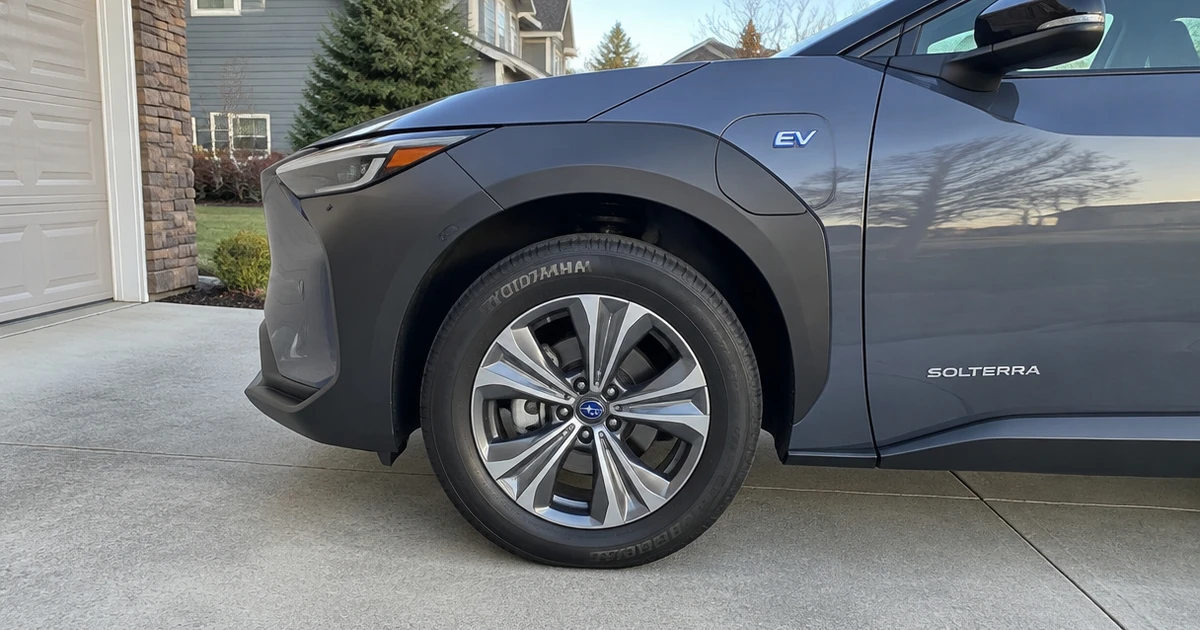
A good tire match starts with the vehicle’s fitment requirements, then accounts for the roads and weather you face. Use these checks to narrow your choices and compare the trade-offs that matter to your driving.
Size and Ratings
Start with the size and ratings on the driver-door placard or in the owner’s manual. Match the full tire size, load index, and speed rating, not just the wheel diameter.
A tire with too little load capacity can run hotter and wear faster under an electric SUV’s weight. A different overall diameter can also affect speed readings and clearance.
Use the placard as your baseline and choose replacements that meet the vehicle maker’s requirements. Compare each sidewall marking before looking at tread style or efficiency claims. The table lists the key checks.
| Check | What to match |
|---|---|
| Size | Placard or manual fitment |
| Load index | At least the vehicle requirement |
| Speed rating | Meets the vehicle requirement |
Load and Electric Vehicle Use
The Solterra’s battery adds mass, and an electric motor can deliver strong torque as soon as you press the accelerator. Choose a tire with load capacity suited to the vehicle and a tread compound that holds up under that workload. If you often carry passengers or cargo, follow the manual’s full-load guidance rather than judging by your solo commute.
Steady starts and stops can limit wear, but the tire itself still needs the right construction. Some EV-focused tires use reinforced structures and low-rolling-resistance compounds. Treat those features as useful clues, then confirm that the tire meets the exact size and rating requirements for your vehicle.
Climate and Traction
Your weather should shape the tread choice. In frequent rain, look for circumferential grooves and channels that move water away from the contact patch, plus a strong wet-grip record.
For regular snow, check for the Three-Peak Mountain Snowflake symbol, which marks a tire that meets a defined severe-snow traction standard. That mark helps, but it does not make an all-season tire equal to a dedicated winter tire in deep snow or very cold conditions.
Use this simple guide:
- Frequent rain calls for dependable wet grip and water-clearing grooves.
- Regular snow calls for a severe-snow rating and suitable tread.
- Long cold spells or icy roads call for dedicated winter tires.
If you get mild winters, an all-weather tire may offer a useful year-round balance. Drivers who face ice or long periods below freezing should use winter tires and change them seasonally.
Range and Cabin Noise
Rolling resistance affects how much energy a tire uses as it rolls, so it can influence range. Low-resistance designs may help, but your speed, temperature, terrain, pressure, and cabin heating also shape real-world distance. Compare independent efficiency tests when available, and weigh any range gain against wet grip and winter needs rather than treating efficiency as the only goal.
Noise also stands out in an EV because the motor makes less sound than an engine. Tread patterns that limit pattern noise, along with sound-absorbing foam inside some tires, can make the cabin calmer. Keep pressure at the door-placard level; underinflation can add heat, wear, and energy loss.
Tread Life and Maintenance
Tread life depends on compound, alignment, pressure, road surface, and how hard you accelerate. A mileage warranty can help you compare expected service life, but read its conditions: coverage often depends on required rotations, proof of maintenance, and minimum remaining tread. A longer warranty does not promise that every driver will reach the stated distance, especially with frequent hard starts or rough roads.
Rotate tires on the schedule in your manual and check pressure when the tires are cold. Inspect the tread for uneven wear; wear along one edge can point to alignment trouble. Have the cause checked promptly, since a new tire will also wear quickly if the vehicle needs service.
Steering and Ride Comfort
Think about how the Solterra feels on the roads you use most. Stable shoulder blocks and a firmer construction can give more direct steering, while a softer setup may smooth rough pavement. Tire design always involves trade-offs, so look for independent handling and comfort tests on a vehicle close in weight and size to yours.
Drivers who spend most miles on highways may prefer a calm, predictable touring tire. If your routes include steep roads or frequent hard rain, give braking and cornering grip more weight than a small reduction in rolling resistance. Keep the same tire type and size across all four wheels unless the vehicle maker allows another setup.
Frequently Asked Questions
What tire size should I buy for a Subaru Solterra?
Read the tire size and ratings on the driver-door placard or in the owner’s manual. Model year, trim, and wheel package can affect fitment. Match the full size, load index, and speed rating, then confirm that the replacement suits the vehicle’s approved wheel setup.
Are all-season tires enough for a Solterra?
All-season tires suit drivers in mild climates with occasional light snow, but they may struggle in frequent snow, ice, or long cold spells. If winter roads are part of your routine, choose a tire with a severe-snow rating or use dedicated winter tires during cold months.
Do electric vehicles need special tires?
No. Standard passenger tires can work if they match the vehicle’s required size, load index, and speed rating. EV-focused designs may add a stronger structure or reduce rolling resistance and road noise, but those traits do not replace fitment checks or strong wet and winter grip.
Can tires change driving range?
Yes. Rolling resistance changes how much energy the tire uses as it turns, and that can affect distance per charge. The effect varies with temperature, speed, pressure, terrain, and driving style. Keep tires properly inflated and choose a tire that balances efficiency with the grip your climate requires.
How often should I rotate the tires?
Follow the rotation schedule in the owner’s manual, since intervals and patterns can vary by vehicle. Check pressure when tires are cold, and inspect the tread regularly for uneven wear. A prompt alignment check can help prevent one edge from wearing faster than the rest.