
This post may contain affiliate links. As an Amazon Associate I earn from qualifying purchases. If you choose to make a purchase, I may earn a small commission at no extra cost to you.
Choosing tires for a Nissan Patrol can feel tricky because the same SUV may spend most of its time on paved roads, haul a family and gear, or tackle rough tracks. A tread that suits one routine can add noise, wear quickly, or give up useful grip in another. Fit matters just as much as tread.
Start with the size and load rating listed for your exact Patrol, then weigh your usual roads, climate, towing and comfort needs. The best tires for Nissan Patrol you can buy in 2026 should balance those demands without forcing compromises you do not need. The options below cover touring, all-weather, all-terrain and street-focused driving, so you can narrow the choice to your use.
Our Top Tires for Nissan Patrol Picks


More Details on Our Top Picks
Pros
- Run-flat support after pressure loss
- Grooves help channel water away
- Strong wet and dry traction
- Responsive handling and braking
Cons
- Summer compound limits cold-weather use
- Run-flat construction can make the ride firm
Run-flat construction gives the Bridgestone Alenza 001 a practical advantage for road-focused Patrol driving. After a puncture or pressure loss, you can travel up to 50 miles at speeds below 50 mph, giving you a chance to reach a safe stop.
Its summer compound grips in both wet and dry conditions, while circumferential and lateral grooves channel water away from the contact area. That tread design helps the tire resist hydroplaning and maintain steady braking on wet roads.
The Alenza 001 also delivers responsive handling and composed road manners, which suit a large SUV that spends much of its time on pavement. Its tread compound promotes even wear, so the tire can keep its road behavior over time.
Bridgestone built this as a summer performance tire, not a year-round option for cold or snowy conditions. The run-flat feature and wet-road control make it a capable match for a Patrol used mainly for paved travel.
Bottom line: Choose the Bridgestone Alenza 001 if you want a summer road tire with run-flat support for your Patrol. It suits drivers who value wet-road control and handling on paved routes.
Pros
- All-season design for changing weather
- Silica-rich compound balances grip and rolling resistance
- Predictable wet-road handling
- Touring focus suits paved driving
Cons
- Not built for deep mud or rocky trails
- Limited grip in severe winter conditions
For a Patrol that spends most of its time on pavement, the Pirelli Scorpion Verde brings an all-season touring focus. Its SUV-oriented tread balances steady road grip with a comfortable feel for daily driving.
Pirelli uses an asymmetric tread pattern and a silica-rich compound to balance traction with lower rolling resistance. Circumferential grooves move water away from the tread, while the design keeps steering response predictable on wet roads.
The Scorpion Verde favors calm road manners over an aggressive off-road tread. On dry pavement, it feels composed and controlled, and its all-season design gives you more flexibility through changing weather than a summer tire.
That versatility does not make it a deep-snow or rough-trail tire. The Pirelli Scorpion Verde fits Patrol owners who mainly drive paved routes and want year-round road comfort with dependable wet-weather behavior.
Bottom line: The Pirelli Scorpion Verde suits Patrol drivers who want a composed touring tire for daily pavement use. Choose it for all-season flexibility rather than demanding off-road work.
Pros
- Quiet ride for an SUV tire
- Confident wet braking and handling
- Responsive year-round road behavior
- Backed by a 60-day trial
Cons
- Road-focused tread lacks deep-trail grip
- Less suited to heavy mud
A quiet cabin is one of the Continental CrossContact LX Sport’s main strengths. Continental tuned this SUV tire for original-equipment use, with a tread design that keeps road noise down and gives passengers a more comfortable ride.
The tire also delivers responsive handling throughout the year, so steering feels consistent as road conditions change. Its wet-road focus gives you confident braking and control when rain covers the pavement.
Wide tread grooves channel water away from the contact area, while the tread layout balances grip with smooth road manners. The CrossContact LX Sport feels at home on paved routes where comfort and predictable handling matter more than trail traction.
Continental backs the tire with a 60-day trial, giving you a chance to judge its road feel. The CrossContact LX Sport suits a Patrol that works mainly as a family or travel vehicle, where low noise and wet-weather control count.
Bottom line: Consider the Continental CrossContact LX Sport for a Patrol used mainly on paved roads. It fits drivers who value cabin comfort and composed wet-weather handling.
Pros
- Reinforced sidewalls resist trail damage
- Mud-phobic bars improve mud traction
- Serrated shoulders add grip in snow
- 50,000-mile treadwear warranty
Cons
- Tread creates extra road noise
- Less comfortable on smooth pavement
Loose gravel, muddy tracks, and rough trails call for a tougher tread, and the BFGoodrich All-Terrain T/A KO3 brings that kind of construction. Its new all-terrain compound and tread pattern target durability and traction across mixed surfaces.
BFGoodrich uses CoreGard Technology, developed for Baja racing, to reinforce the sidewalls against damage. Advanced Deflection Design helps deflect sticks and stones, while the serrated shoulders and mud-phobic bars add bite in mud and snow.
The KO3 also handles gravel well, where its compound and tread resist wear during repeated use. On a Patrol that leaves pavement often, the tire gives you useful traction without limiting you to a mud-only design.
BFGoodrich backs the KO3 with a 50,000-mile treadwear warranty and a six-year limited warranty. Its blocky tread brings more road noise on pavement than a highway-focused tire, but the tough sidewall design suits demanding routes.
Bottom line: The BFGoodrich All-Terrain T/A KO3 suits Patrol owners who regularly travel gravel roads or rough trails. Pick it for tough sidewalls and all-terrain grip.
Pros
- Three-Peak Mountain Snowflake certified
- Open tread clears loose debris
- Stone ejectors push out lodged rocks
- Silica-enhanced compound aids wet grip
Cons
- Louder on pavement than a highway tire
- Tread feels less refined on smooth roads
Toyo built the Open Country A/T III to handle changing surfaces without giving up everyday road use. Its all-terrain tread uses open grooves to clear water and loose debris, while sturdy tread blocks dig into gravel and dirt.
The tire carries Three-Peak Mountain Snowflake certification, which marks it for use in severe snow conditions. Closely spaced sipes add biting edges across the tread, and Toyo’s silica-enhanced compound helps maintain grip on wet roads.
Stone ejectors in the tread help push out rocks that could lodge between the blocks. That feature, combined with the A/T III’s all-terrain pattern, suits a Patrol that moves between paved roads and gravel tracks.
The Toyo Open Country A/T III brings snow-rated versatility to a practical all-terrain design. Its open tread can create more noise on pavement than a highway tire, but the extra bite pays off when your route includes snow or loose ground.
Bottom line: The Toyo Open Country A/T III suits Patrol drivers who face snow, gravel, and regular paved travel. Choose it for all-terrain traction with a snow-rated tread.
Pros
- 60,000-mile treadwear warranty
- Snowflake-certified for severe snow
- Enduro compound resists cuts and chips
- Strong load-carrying construction
Cons
- Deep mud can overwhelm its tread
- Less aggressive than a mud-terrain tire
Endurocore construction gives the Yokohama Geolandar A/T G015 a sturdy base for carrying loads and handling rough roads. Yokohama pairs it with a cut- and chip-resistant Enduro compound to limit damage from gravel and broken pavement.
The G015 carries Three-Peak Mountain Snowflake certification, so its tread meets the standard for severe snow conditions. Its all-terrain design also keeps a more road-friendly feel for daily driving than a tire built mainly for mud.
Yokohama backs the G015 with a 60,000-mile limited treadwear warranty and a 30-day satisfaction guarantee. The tire’s mix of snow traction, road manners, and tough construction suits a Patrol that sees varied weather and regular highway use.
The Geolandar A/T G015 handles light trail work, wet roads, and winter travel with a balanced feel. Deep mud remains a tougher task for its road-oriented all-terrain tread, but the construction serves well across many everyday conditions.
Bottom line: Consider the Yokohama Geolandar A/T G015 if your Patrol sees changing weather and mixed road surfaces. It suits drivers who want snow capability with a useful treadwear warranty.
Pros
- 3D Canyon Sipes resist tread wear
- Snowflake-certified for winter traction
- Heat Diffuser Technology manages heat
- Rugged shoulders bite into loose ground
Cons
- Tread adds road noise
- Higher rolling resistance than a highway tire
If your Patrol carries a load over rough roads, the Falken Wildpeak A/T3W brings tread features aimed at stability and wear. Its 3D Canyon Sipe Technology locks tread blocks together under high torque, helping the tire resist uneven wear and hold its shape.
Falken adds deep grooves and rugged shoulders for traction on dirt, gravel, and snow. The A/T3W also carries Three-Peak Mountain Snowflake certification, making it a capable pick for winter roads as well as dry trails.
Heat Diffuser Technology in the lower sidewall helps manage heat around the tire’s internal components. That matters during long drives with a load, when heat can build as the tire works over rough surfaces.
The Falken Wildpeak A/T3W balances all-terrain traction with stable handling on pavement. Its aggressive tread can produce more noise and rolling resistance than a highway tire, but the interlocking sipes help it stay composed under torque.
Bottom line: The Falken Wildpeak A/T3W suits Patrol drivers who carry loads and travel on mixed terrain. Pick it for stable handling and snow-ready all-terrain traction.
Pros
- Strong dry-road grip
- Confident wet braking
- SUV-focused tread construction
- Quiet, comfortable highway ride
Cons
- Summer tread lacks winter traction
- Not suited to rough off-road use
Sharp steering and strong braking define the Michelin Pilot Sport 4 SUV. Michelin built this summer tire for SUVs, pairing an asymmetric tread design with a road-focused compound for confident dry grip and wet braking.
The tread channels water away through wide grooves, while its outer shoulder supports cornering on dry pavement. That balance gives a large Patrol a more controlled feel on paved roads, especially when you want quick steering response.
Michelin also gives the tire a robust SUV tread pattern to support long-term use. Its design limits road noise and keeps the ride comfortable, so the focus on performance does not make everyday highway travel feel harsh.
The Michelin Pilot Sport 4 SUV brings summer performance and wet-road braking to a road-focused Patrol setup. Its warm-weather compound does not suit icy or snowy roads, so its strengths fit best in mild conditions.
Bottom line: Choose the Michelin Pilot Sport 4 SUV for a Patrol used mainly on paved roads in warm weather. It suits drivers who put steering response, wet braking, and ride comfort first.
Factors to Consider When Choosing Tires for Nissan Patrol
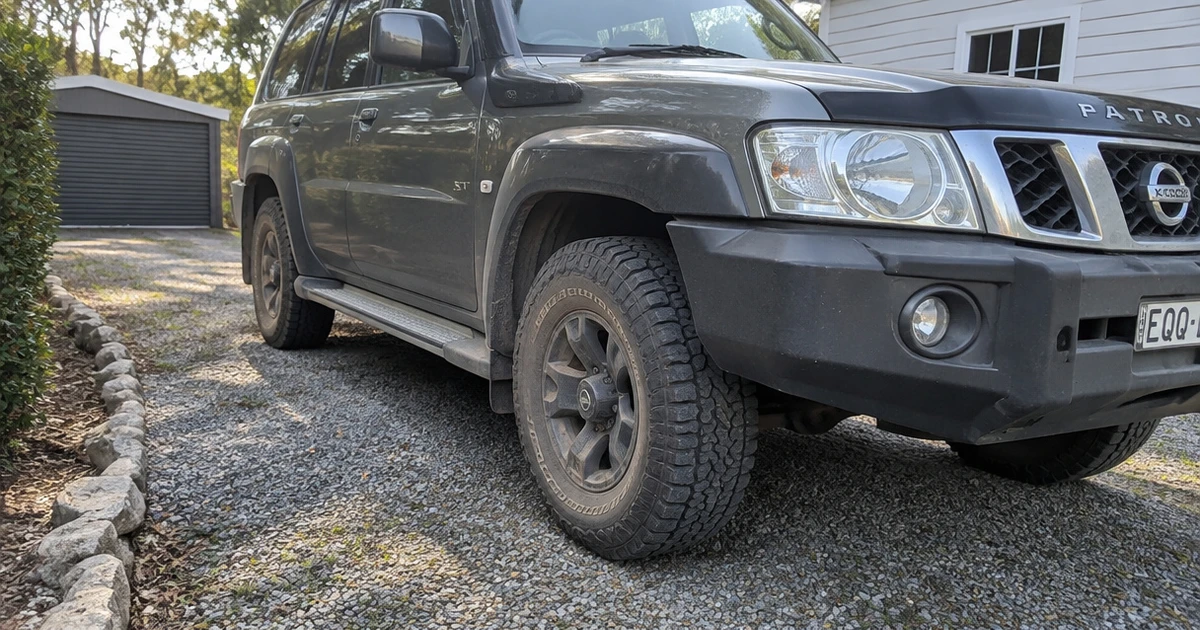
Before you compare tread patterns, check your Patrol’s placard and owner’s manual. They identify approved fitment and cold-pressure guidance for your specific model.
Then use your usual load, roads and climate to narrow the tire type. A few minutes spent confirming compatibility can save you from noise, uneven wear or poor clearance later.
Size and Load Rating
The door placard and owner’s manual give the approved tire size, wheel fit and cold inflation pressure for your specific Patrol. Match the full size code, not just the wheel diameter. The load index and speed symbol also matter; choose a tire that meets the vehicle maker’s minimum ratings, especially if you carry passengers, cargo or a trailer often.
Patrol versions and wheel packages can call for different fitments, so do not assume another owner’s setup suits yours. Larger tires can rub at full steering lock, alter speedometer readings and change gearing. Check clearance, spare-tire fit and local rules before changing diameter, and ask a tire shop to confirm the fit on your exact vehicle.
Tread Type and Terrain
Pick a tread pattern for the surfaces you drive most. Highway-focused tires suit paved commutes and long trips, where their closely spaced tread blocks often bring lower noise and smoother handling. All-terrain designs add open grooves and tougher construction for gravel, dirt and occasional trail use, but the extra tread can bring more road sound and a firmer feel.
Mud-terrain tires make sense if deep mud and loose ground show up often. Their large voids clear dirt well, though they can feel less settled on pavement and may wear faster under road-heavy use. Use this quick guide:
- Mostly pavement: highway or touring tread.
- Mixed pavement and trails: all-terrain tread.
- Frequent mud or rocky routes: mud-terrain tread.
Climate and Seasonal Grip
Think about the coldest and wettest conditions you face, not only the weather on purchase day. Many all-season tires suit mild climates, but winter rubber stays flexible in cold weather and winter tread helps on packed snow. In places with regular snowfall, look for the three-peak mountain snowflake (3PMSF) mark, which shows the tire meets a snow-traction test.
A 3PMSF mark does not promise strong ice braking, and an M+S mark alone does not meet that same snow test. Choose dedicated winter tires if icy roads dominate and you can swap them seasonally. In warm regions, wet-road grip and water-clearing grooves may matter more than snow performance.
| Conditions | Marking or type | What it suits |
|---|---|---|
| Mild winters | All-season | Rain and occasional light snow |
| Regular snow | 3PMSF-marked | Frequent snowy roads |
| Ice and deep cold | Dedicated winter | Seasonal cold-weather use |
Ride Comfort and Handling
Your Patrol’s weight makes tire construction and tread layout matter for steering feel as well as cabin noise. If most miles happen on pavement, favor a road-oriented tread with stable center ribs and smaller tread blocks; these features can calm the ride and reduce hum. For rough routes, tougher sidewalls can resist damage, though a stiff casing may pass more bumps into the cabin.
Do not pick a tire solely by a low noise label or an aggressive shoulder look. Read the maker’s stated use and check load and speed ratings against your vehicle’s requirements. A tire that carries your typical load without running near its limits can feel more composed, especially during towing or highway travel.
Pressure, Wear and Replacement
Use the cold pressure from your vehicle placard, not the maximum printed on the tire sidewall. Check pressure before a long trip and after major temperature changes; underinflation builds heat and can wear shoulders, while excess pressure can reduce grip and wear the center. Follow the vehicle manual if you tow or carry heavy loads, since it may give separate guidance.
Rotate at the interval in the manual and inspect for uneven wear, cuts, bulges or stones in grooves. Replace tires when tread reaches the legal limit where you drive, or sooner if damage or poor wet grip appears. Replace all four with matching type and size when possible; mismatched tread depth can affect traction and handling in a four-wheel-drive system.
Frequently Asked Questions
What tire type works best for a Nissan Patrol?
The right tire depends on where you drive and how you load your SUV. Highway tread suits mostly paved use, while all-terrain tread helps if you regularly leave pavement. If deep mud or severe winter weather forms part of your routine, choose a tire made for those conditions and accept the related road-noise or seasonal trade-offs.
Can I fit larger tires on my Nissan Patrol?
You can, but check the vehicle placard, wheel width and clearance before you change diameter. A larger tire can rub during turns or suspension travel, alter speedometer readings and affect gearing. Confirm spare-tire fit and local rules, then have a qualified tire shop verify the setup on your exact Patrol.
What tire pressure should I use?
Use the cold pressure listed on the vehicle placard, not the maximum printed on the tire sidewall. Check it before driving, since heat raises pressure after you start moving. If you tow or carry heavy loads, follow the vehicle manual for any separate pressure advice.
Are all-terrain tires suitable for daily driving?
All-terrain tires can work for daily driving if you value added grip on gravel or trails. Their open tread may create more hum and a firmer ride than a road-focused tire, and road use can wear them faster than expected. Match the tread to how often you leave pavement.
When should I replace my Patrol’s tires?
Replace a tire when it reaches your area’s legal tread limit, shows damage, or loses wet-road grip. Inspect the sidewalls and tread often, and have a shop check bulges or cuts. On a four-wheel-drive Patrol, matching all four tires in size and similar tread depth can help preserve balanced traction.